
|
|


.png)


Don't miss your Arrival Notice! | Contact your agent | TRANSHIPMENT ETA
Arrival Notice in International Shipping from the USA
Please pay close attention to the Arrival Notices when cargo reaches its destination.
In respect of international cargo transportation from the USA LCL, an Arrival Notice (Notice of Arrival, AN) is the document issued by an ocean freight carrier's destination agent to the consignee (the recipient of importing goods) and to their notify parties, if any, to inform them that the shipment is arriving at the place of delivery.
The AN provides details of the arriving cargo. It corresponds to the sea freight Bill of Lading for international shipping. It should also provide initial instructions on recovering imported goods, destination charges for freight release, and a list of documents required for international shipping to facilitate release. It should contain:
- Commodity description,
- Sailing details,
- Destination country customs-related charges,
- Overseas agent's contact details,
- LOT number associated with the arriving cargo,
- Initial instructions on the import recovery, etc.
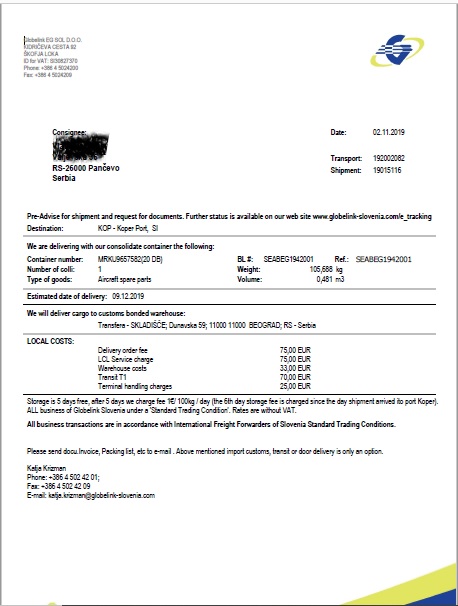
Remember that an Arrival Notice is NOT a freight release document. It is a document that authorizes the consignee to file the entry into the destination country's customs zone and initiate import recovery under the country's law.
Also, please remember that the destination agent may contact you when your cargo arrives at a PORT OF DISCHARGE, but at the PLACE OF DELIVERY, as in your Bill of Lading. Then, you must begin working with them to ensure your load reaches the delivery location without delay. At this time, if necessary, you may discuss the business of delivery of your cargo "to your door."
Please note that the agency will likely receive information about your incoming cargo a few days before your freight's arrival. If you contact them too early, don't be frustrated that they are unaware of your shipment. Leave them a copy of your BOL, reconfirm your contact information, and wait for a message/in a few days before the entry time.
Parties Involved in the Import Recovery
- The consignee (in respect of import recovery, called Importer of Records),
- Destination country's officials (Customs, Government agencies that may be concerned with imported goods, Customs and border protection officers, etc.),
- An overseas agent,
- A Customs broker licensed in the country. Most of the time, the agency supports customs brokerage services.
- Other parties related to the import recovery and the delivery (if necessary) "to the door" of the recipient of the importing goods: domestic freight forwarders, bonded and local warehouses, local cargo transportation companies, etc.
Please note that import recoveries in international shipping are complex and time-sensitive. Even though most countries worldwide allow consignees (importers of records) to work on import recoveries directly with Customs, unless you are a professional in customs, it is a good idea to hire a licensed customs broker.
When shipping from the U.S. via LCL, unlike with FCL, you always have an ocean carrier representative responsible for deconsolidating your cargo. Most of the time, they will assist you in customs clearance procedures for a reasonable fee. However, they may occasionally ask you to clear your imported goods through customs. Then you need to engage a customs broker licensed in the country.
Please keep in mind that if, for any reason, you forget or miss a message that your imported goods are arriving, it does not mean that the destination country's officials will forget about it.
DO NOT MISS YOUR ARRIVAL NOTICE!
An AN in your international shipping should be issued to your consignee and a notified party (if any) by the carrier's destination agent several days before your goods enter the country's commerce zone. Their contact information is on your Bill of Lading. Depending on the BOL format, it is under 'FOR DELIVERY PLEASE APPLY TO' or 'To Pick up Freight, Please Contact' or 'PRESENT DOCUMENTS TO':, etc.
DO NOT MISS YOUR ARRIVAL NOTICE! UPON RECEIPT, START WORKING ON YOUR IMPORT RECOVERY WITH THE AGENT WITHOUT DELAY. KEEP YOUR EYES ON YOUR IMPORT RECOVERY! DO NOT LET IT GO OUT OF YOUR CONTROL.
Typically, your consignee will be notified via the email address listed on your B/L. Having a valid email address for your consignee in your contacts is crucial! Please monitor your email during the estimated entry window.

You can always track your shipment on your carrier's website using your booking or B/L number.
Please note that when tracking your shipment on the website, the transshipment ETA may not be available until your international shipment arrives at the Port of Discharge and is confirmed onboard for transshipment.
SHIPMENTS WITH TRANS-SHIPPING: If a Port of Discharge on your Bill of Lading differs from the Place of Delivery, then the ETA of your shipment may NOT be to the final destination. It can be to the Port of Discharge, where your cargo will be handled for further transshipping to the Place of Delivery.
In other words, when tracking your shipment on the carrier's website, always check the TRANSSHIPMENT ETA unless the Port of Discharge is your final destination. The TRANSSHIPMENT ETA is the expected arrival time at the destination. Do not confuse the ETA and the TRANSHIPMENT ETA.
There are various modes of transshipment in international maritime shipping. Cargo can be reloaded onto another vessel or transported by rail or truck, or both. Your shipment will take longer to reach the Place of Delivery. Ground transportation from a port of discharge to a landlocked city may take 10-15 days or more. If the Port of Discharge is a hub seaport, such as one connecting Europe to Africa or Asia to Oceania, reaching the final destination may take 25 days or more.
Do not hesitate to contact your overseas agent.
Please note that the overseas agency may not receive specific information about your shipment until a few days before it arrives at the Place of Delivery or the TRANSIPMENT ETA. Feel free to contact them in advance. If you haven't received information about your shipment, send them a copy of your Bill of Lading. Confirm your contact information with them and wait for your arrival notice.
IF, FOR ANY REASON, YOU ARE NOT NOTIFIED AS EXPECTED, DO NOT HESITATE TO CONTACT THE AGENCY. Email or fax them a copy of your BOL. Reconfirm your contact information, and insist on the AN. Otherwise, storage charges, Customs penalties, and other significant expenses may occur due to a delay in your import recovery.
Do not ignore or postpone the recovery of your imported goods!
IMPORTANT!! Since you decided to ship goods from the U.S. overseas, you must clearly understand that U.S. laws do not apply to your freight as soon as your goods exit the U.S. Commerce zone. Neither a U.S. freight forwarder nor an ocean freight carrier can assist you in your import recovery overseas. The carrier's overseas representative should be able to assist you. However, they are not a U.S. business. Only your consignee (professionally referred to as the Importer of Records) can be aware of and address issues that may lead to problems with importing goods.
Yes, international maritime laws should apply to your freight. However, the laws may be interpreted differently depending on the country to which you ship. Do not say anything about other subjective factors peculiar only to the country where you ship.
With LCL, you do not usually need to hire a customs broker. Typically, the carrier's agent is also the customs broker. However, we recommend that, in the event of issues, your first step is to seek assistance from an independent customs broker licensed in the destination country.
What can we suggest if you experience issues recovering your internationally shipped items?:
- If, for any reason, you are not contacted by the agent within a few days before ETA, do not wait. Contact them first. The contact info is in your Bill of Lading.
- Always request a legal Arrival Notice. It must be dated, on the agency letterhead, and include a breakdown of local charges. Phone calls or random emails are not enough.
- Work appropriately with the agent. Respect their job. Their business is to get your goods for you as soon as possible. Follow the agency's instructions. Pay local charges and possess your released goods.
- If you encounter any issues with international shipping from the USA, please don't hesitate to contact us. However, if you do not provide a copy of your letter, we will most likely be unable to work with the carrier on your behalf. In other words, we will always need a copy of the document.
Remember: Import recoveries are time-sensitive! The more quickly you begin working on them, the less likely you will be to incur the deadline penalties: storage, demurrage, Customs penalties, etc.


